Showing posts with label In the Field. Show all posts

Sticking a Fork in 2016

If nothing else, 2016 was an interesting year.


Lesson learned:
1. Never look at puppy photos on Facebook too long or too often. Your will to resist WILL wilt.
2. Kent's new bismuth ammo ROCKS!
3. Less is more. 

Progress made:
1. My website got a new look.
2. I actually wrote a few pages for my next book (still about 300 to go...)
3. The Picardy Spaniel population of North America went from 1 to 7!

Setbacks and loses:
1. Souris-Manon passed over the rainbow bridge.
2. The snipe flight was non-existant.
3. We didn't get a deer.

Goals for next year:
1. Travel more (France here we come!)
2. Hunt more
3. Write more (and take more photos and more video)

Below are links to all the photo narratives I posted in 2016. Enjoy!


AUTUMN 2016 by Dog Willing Publications on Exposure


Léo at One by Dog Willing Publications on Exposure


Souris-Manon by Dog Willing Publications on Exposure


Red River Run by Dog Willing Publications on Exposure


SOON! by Dog Willing Publications on Exposure


The Eagle Has Landed by Dog Willing Publications on Exposure


Léo! by Dog Willing Publications on Exposure


WINTER by Dog Willing Publications on Exposure

On Range


Hunting dogs are generally categorized according to the job they are expected to do and the manner in which they should do it. Thus the retrieving breeds; Labradors, Chesapeakes, Golden, Flat and Curly Coats, are used to do what their name would imply. They retrieve shot game to the hunter. While there may be some debate about the finer points of the expected performance, there is no disagreement about the basic task: the dog must leave the hunter, make its way to the downed game, pick it up and bring it back.

The flushing spaniels, Springers, Cockers, Clumbers, Sussex, Welsh and Field are selected, bred and trained to search for game and force it to flight within gun range of the hunter. They are expected to retrieve downed game as well. Here again there may be some disagreement regarding the exact manner in which the dog should work, but the basics are not in dispute. The dog must seek and flush game within range of the gun and retrieve what is shot.


Pointing breeds however, do not enjoy such a consensus of opinion when it comes to how they should do their job. Other than agreeing that the dog should find and point game, everything else, from searching to retrieving, to tracking, to pace, and gate, even to the posture the dog assumes while pointing can be, and usually is, the subject of heated debate among pointing dog enthusiasts.


This is one of the principle reasons that there are so many more breeds of pointing dogs than there are retrievers or flushing spaniels. Different pointing breeds have been developed to perform similar tasks but in sometimes very different ways. Furthermore, many breeds can now be subdivided into different strains with field performance characteristics so dissimilar that they can almost be considered different breeds altogether.

The one area that stands above all others as a source of endless debate, especially in America, is the question of range. Since a pointing dog’s main purpose in the field is to find game, point it and, hopefully, hold the game there until the hunter arrives, it can work at distances beyond the range of a shotgun. So the question then becomes, how far is too far?

Traditionally, all of the Continental breeds were selected and trained to hunt only slightly further out than flushing dogs, about 50 or 60 meters at the most. Nowadays, a few breeds are still supposed to have that sort of range, but most are expected to run somewhat wider than that, at least some of the time. What’s more, over the last 50 years, bigger and faster running strains within most breeds have been developed. In fact, in some breeds, there are now lines of dogs that approach the speed and range of English Pointers and English Setters.


Be that as it may, I have come up with a chart that illustrates the typical range for each of the Continental pointing breeds, but we need to keep the following things in mind when consulting it.

THE BEST RANGE IS THE ONE THAT SUITS YOU: One of the most common sources of frustration among pointing dog owners is a mismatch between the range the hunter would like his dog to run at, and the range the dog’s genes tell it to run at. Most experts agree that a pointing dog’s range is largely an inherited trait. There are methods that can be employed to modify this range making a wide-ranging dog work closer or, more difficultly, making a close-working dog range further out—but in general the distance from the handler at which the dog is most comfortable hunting is mainly determined by its genes. So, finding a breed that has the kind of range you are comfortable with, and is suitable for the game and terrain you hunt, is very important.

THESE ARE BALLPARK FIGURES: The chart is not based on anything close to a scientific survey. Some of the distances given are based on the preferred ranges stated in the breed’s published work standard, but most are based on nothing more than the breed’s reputation or the generally accepted norm as expressed to me by the breeders and owners I have spoken to.

THERE ARE EXCEPTIONS: There are outliers in every breed. Some may run way bigger than the average, and others may work closer in. In many breeds, this applies to various strains and lines that may show significant differences in range. That is why the chart shows a wider spectrum of ranges for some breeds.


“HORSES FOR COURSES”: Generally speaking, within any given breed, breeders who select their stock for field trials tend to produce dogs that are toward the bigger running end of the spectrum. Other breeders may seek to produce closer-working dogs suitable for different types of terrain or game.


TO THE FRONT OR SIDE TO SIDE: In some countries, dogs are expected to run in a windshield wiper pattern in front of the hunter. In that case, the distances given would indicate how far the dog usually ranges out to one side or the other. In other countries, dogs are encouraged to “seek objectives”. They should run to areas of cover that are likely to hold birds no matter where they may be, to the left, to the right, or out in front.

DOGS ADJUST THEIR RANGE: The distances given reflect the usual range for the breed when hunting in open fields. Most dogs will adjust their range when working in tighter cover. The same dog that ranges out to over 300 meters across a stubble field for grey partridges might not go beyond 40 or 50 meters in the alder thickets in pursuit of woodcock. And yes, as mentioned above, a dog’s range can be adjusted. But it is easier to teach a wide-running dog to stay closer than it is to make a close working dog work further out


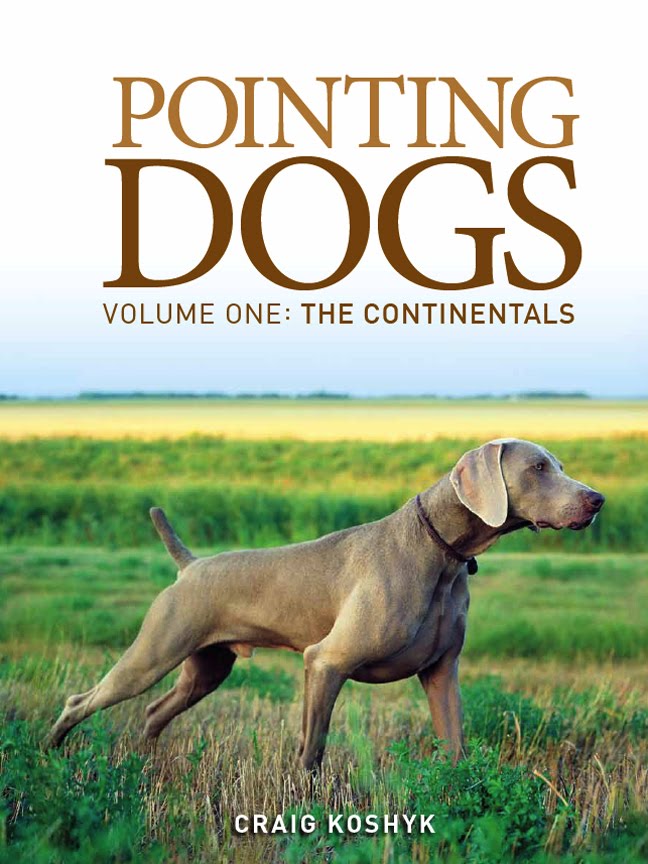
Enjoy my blog posts? Check out my book Pointing Dogs, Volume One: The Continentals

www.dogwilling.ca

In South Dakota, For a Little While

The land belongs to the future, Carl; that‘s the way it seems to me. How many of the names on the county clerk‘s plat will be there in fifty years? I might as well try to will the sunset over there to my brother‘s children. We come and go, but the land is always here. And the people who love it and understand it are the people who own it—for a little while. ― Willa Cather


Well the weatherman is calling for snow tomorrow and there's only a few more days of deer season left. That means the 2015 hunting season is pretty much history. Sure, I we may get out a couple more times for grouse if the snow ain't knee-deep, but for all intents and purposes, our trip to South Dakota last week was the last big adventure of the year.

And what an adventure it was! Even though we could not bring any birds back with us (there is a complete ban on the importation of anything remotely resembling a chicken to Canada due to avian flu stateside), we still managed to take (and eat) a few. More importantly, we managed to get some great photos of some very nice dogs and their friendly owners.


And I really need to thank an the Upland Journal's awesome online discussion forum for much of our success! You see, a few weeks before we headed south I submitted a post asking anyone running Pointers and/or Setters in ND or SD to drop me a line if they would let me photograph their dogs in action. It wasn't long until Brad Adrian stepped up and offered to let me follow him and his sweet Pointer Peanut as they chased prairie birds near Pierre. Along with Brad were few other UJ members, and one of them also had a couple of really nice Pointers.

So Lisa followed them with our Canons instead of shotguns. We could not have asked for better conditions. The temps were near perfect, the light was just right and the hunters, dogs and birds put on a great show. We managed to get some shots that we are really happy with, one or two of which I am pretty sure will make it to my next book.

If you'd like to see a selection of our favourites, check out the 2015 hunting gallery below. It features shots spanning the entire season, in reverse chronological order from South Dakota to North Dakota to Manitoba.

Enjoy!!


LA BELLE SAISON by Craig Koshyk on Exposure


Enjoy my blog posts? Check out my book Pointing Dogs, Volume One: The Continentals

www.dogwilling.ca

Pursuit: Photos of Hunters and Huntresses in The Field


I guess most people would describe me as a photographer of gundogs. And it’s true. I do spend ungodly amounts of time, energy and money capturing images of gundogs. But along the way, I also snap a shot or two of the hunters and huntresses who follow the dogs, ready to harvest the game their canine companions manage to outwit.

Below are some of my favourite images of the hunters and huntresses with whom I’ve had the honour of sharing the most precious moments of my life. I hope you enjoy looking at them half as much as I enjoyed taking them.

Place your mouse over the first image and scroll down to view the others.


PURSUIT by Craig Koshyk on Exposure


Enjoy my blog posts? Check out my book Pointing Dogs, Volume One: The Continentals

www.dogwilling.ca

South Dakota Dogs!

A few weeks before my birthday, my wife asked me how I would like to celebrate it. We could have a big party at home, or we could travel to South Dakota to hang around with great people and great dogs. I chose the latter. Because I am a dog nut.


The Huntress


The Huntress by Craig Koshyk on Exposure


Enjoy my blog posts? Check out my book Pointing Dogs, Volume One: The Continentals
http://www.dogwilling.ca/index.cfm


It's TIME!!!


In the immortal words of Bruce Buffer...


The 2014 hunting season is now upon us, and it is a very special one indeed. It is Lisa's very first season with a gun. For many years, Lisa has been 'hunting' with a camera. Many of her awesome images are posted right here on this blog and some are featured in Pointing Dogs Volume One: The Continentals. But this year, armed with her brand new Yildiz A5 side by side (a sweeeeet gun!), she will be doing her best to put some free-range, organic meat on the table. And I will try to capture as much of the action as I can with my still and video cameras.

So stay tuned. I will be adding photos and videos to http://www.craigkoshykphoto.ca, in the gallery located here: http://www.craigkoshykphoto.ca/p1063773707#h22f6be34

Henri pointing a snipe for Lisa

Lisa's first duck in hand.
Lisa's first duck, right out of the oven.

Enjoy my blog posts? Check out my book Pointing Dogs, Volume One: The Continentals
http://www.dogwilling.ca/index.cfm

Better Cold Than Sorry

The fact is, it’s hard to freeze a working dog to death on even the coldest days. But it’s quite easy to accidentally kill a hard-hunting dog on even a mildly warm day. — Brian Lynn

Every year, right about now, hunting publications everywhere run articles warning hunters about the dangers that early season heat can pose to hard driving gundogs. And I've done my best to heed those warnings, even up here in the great white north were anything above zero is considered a 'mildly warm' day.


But last year, despite our best efforts, Henri gave us a scare. We were in North Dakota in late October hunting pheasants. The days were cool and nights were down right cold. Since the dogs were spending nights in the truck, we put insulated covers on their kennels to keep them warm. And the covers worked like a charm. Despite plenty of frost on the pumpkin outdoors, I always found the dogs comfortably warm inside their kennels each morning.


During the day, as we ran one dog, we would leave the others in their kennels. We kept their kennel covers on but we cracked the windows on the truck to make sure things didn't get too warm — even though the outdoor temps never got above 5 degrees (40F).  Again, it worked like a charm. Every time we got back to the truck, we found comfortable dogs eagerly awaiting their turn to hunt.
And then Henri's eagerness got the better of him, and of us. 

Eager Henri
On day three of the hunt, we decided our first stop would be a small patch of great looking rooster cover. Since Uma is our closest working dog, she got the nod.  45 minutes and three roosters later (Uma was on FIRE!!), we were back at the truck. As I opened the tailgate I saw our dog Souris in her crate fast asleep, shivering. Next to her was Henri in his crate. But he wasn't asleep, and he sure as heck wasn't shivering. He was laying on his back, panting, wide eyed. His bright red tongue was hanging out like he'd just run a marathon in the desert!


Henri was showing the classic signs of heat stress. We needed to cool him down, fast. Fortunately, the grass right outside the truck was cold and wet with melted frost. So I opened Henri's crate, picked him up, put him on the ground and said "down!". He was more than happy to oblige. He plopped down and began to roll in the grass as we poured an entire jug of cool water on his belly, under his arms and inner thighs. 


In a couple of minutes Henri was up and around, seemingly no worse for wear. We dried him off and took him for a short walk just to make sure he wasn't woozy or wobbly or suffering from any lingering effects. And right there and then we decided that 1. Henri would not hunt that day. We'd give him some time to recover from what was probably not a severe case of heat stress, but what could have easily been much worse and 2. from now on, when we leave any dog in a crate while we hunt with another, it is better to be cold than sorry.


Henri overheated in a cold truck on a cold day. He was in a crate that was covered with an insulated jacket. And such a setup is designed to keep a dog relatively warm when it is sleeping or just chillaxing waiting for its turn to run. Unfortunately, when we started the day with Uma instead of the usual 'first stringer' Henri, well, let's just say that he did NOT take it lightly. Henri did NOT sleep or chillax. In fact, it seems that while we were in the field with Uma, out of sheer frustration and indignation, Henri decided to paw at the bottom of his crate like he was digging to China. There is no way of knowing how long it took for the crate to heat up, but as Henri threw a tantrum, heat up it did. And heat stress suddenly became an issue.


And there is also no way of knowing what would have happened if we'd been in the field with Uma for longer than 45 minutes. Clearly, Henri had stopped doing whatever he was doing to heat things up before we got back. His brain said 'cut it out you idiot!" and forced him to just lay there and pant. So would he have recovered on his own just by being still (and panting his tongue off)? Or would the temperature have remained high enough, for long enough, to cause permanent damage...or worse?


We will never know. And we never want to find out.


Since Henri's near melt-down, we've installed wireless temperature gauges in the crates so we can monitor them from the cab of the truck as we drive. And we've decided that from now on, when we are in the field with one dog we will leave the others in kennels with all the cover flaps off and all the windows open. The dogs will just have to get used to shivering. It’s hard to freeze a working dog to death on even the coldest days. But it’s quite easy to accidentally kill a hard-hunting dog on even a mildly warm day.


Stay safe everyone!


Enjoy my blog posts? Check out my book Pointing Dogs, Volume One: The Continentals
http://www.dogwilling.ca/index.cfm


Opening Day, Waterfowl 2014


This morning, my nephew Craig James and I headed out at insane o'clock for the waterfowl opener. We had scouted a great new spot over the weekend and were pretty sure that we'd be bringing home some fresh duck for diner. And we were right. By 8:30 am, we had 6 mallards and 3 teal, all fetched to hand by my go-to dog Henri. By 9 am, temps were rising fast so we decided to shed the chest-waders, lace up the upland boots and head to the field in search of snipe. 


Snipe are migratory, so we can hunt them when the general waterfowl season opens, usually a week before the upland season. But in some areas they are actually found in the very same pastures frequented by sharp-tails. So we had a hunch that we'd come across both. And we were right again. Henri had a total of 10 points in a little less than an hour. 6 points were on snipe and 4 on sharptails. All the snipe were singles, the grouse were in pairs for the most part, but one point was a sort of 'popcorn all around him' kind of thing with probably 8-10 birds flushing in one's and two's.


As for our shooting, well... it sucked. We only shot at snipe of course (sharptail season doesn't open till next week), but we missed them ALL! I blame it on the new shells. You see, I ran out of my regular snipe cartridges, so we had to use a new load, Kent TealSteel #6s. And sure, they went 'boom' just fine when we pulled the trigger, I am sure they are a decent load. But blaming them is easier on the ego than blaming our rusty shooting skills, so I will stick with the 'bad shells' excuse until I start knocking down more snipe with them. Then I will change my tune to 'these shells are awesome!'


All the photos in this post are from today's waterfowl hunt. I didn't take the camera with me for the snipe hunt and now I regret it. I am pretty sure I would have shot better with my Canon than I did with my side by side. 


Skinny Puppy?

Yesterday, I posted an article about the new laws for e-collars in Quebec. As usual, I shared the link to the article on various social media platforms and discussion forums. Overall, the article was well received. I got some positive feedback and many 'thanks!' for explaining the nuances of the laws.

But, surprisingly, I also got some very negative feedback about the photo (below) that I posted to illustrate the article. 


The photos is of my dog Henri on an intense point in the middle of the hunting season. It is from a burst of shots that I took machine-gun style as he pointed a covey of nervous sharp-tailed grouse. When I got home and looked at the series, the one I finally chose was the frame of Henri inhaling deeply, taking in a huge gulp of scent. I felt that the shot really showed Henri's muscles, his lean, fit build and the intensity of the point. I then did more than my usual amount of post-processing to the shot, increasing the contrast, clarity, sharpness etc. to add drama and definition to Henri's physique. 

I've used the photo before in other contexts and I've received a lot of compliments on it from people who are used to seeing super-fit field trial dogs or hard core hunting dogs on a super intense point, sucking in scent. But when I posted it yesterday, it seems that some folks only saw a dog that, to them, looked like it was 'starving', 'ill',' or 'abused'.  

And that is fine. I believe that everyone is entitled to an opinion. If they feel that they are able to judge the weight and fitness of a dog in a single photo, then so be it. But basing an opinion on a single photo is almost never a good idea. And if the opinion is backed up by nothing more than a profound lack of knowledge about how hard-core, high-performance dogs actually look when they are doing what they are bred to do in the field or how photos can be 'tweaked' to exaggerate a certain look, maybe that opinion should remain private. Just sayin'

But post they did. Some folks made comments suggesting that I should immediately double or triple my dog's daily food ration to 'put some weight on him'. Others thought I should never hunt a dog in such 'poor' shape. So I thanked them for their concern (sincerely, I am sure they mean well and only want to help) and then I proceeded to explain why they were wrong:

First of all, as mentioned, the image is part of a series of about 15-20 shots taken over the course of maybe 5 seconds, as Henri was pointing a nervous covey of sharp-tailed grouse. Whenever I shoot a series like that, I weed through them after the shoot, deleting the less-than-great shots and only keeping the 'keepers'.

Here is a shot of Henri taken on the same day. To my eye, he looks anything but 'starving'. 


And here are some photos of Henri taken just minutes before I took the series of photos of him on point. 


But the one I kept, tweaked and them posted was this frame taken as Henri inhaled deeply, drinking in a huge gulp of scent. Here it is before any real 'tweaking' in Lightroom and Photoshop:


And here is the shot that was taken half a second later as Henri exhaled. Note how the muscles all look the same, but the ribs are less prominent. 
Obviously not a 'keeper'!

But that is not the only reason the ribs in the posted photo are so obvious. By adjusting the contrast, clarity and other things in the image, all the lines of the physique are enhanced. Here is a comparison on the 'inhale' shot, before (top) and after Lightroom and Photoshop tweaks (bottom):

So another step in the process made the ribs even more apparent. Personally, I like the look...but maybe it is because I like my dogs to look like Georges Saint Pierre (and my wife wishes I looked like Georges...)


But I can understand why some folks might look at the shot and think WOW, what a skinny dog! Maybe they are just not very familiar with the kind of athletic build many of us prefer, and maybe they are not aware of just how much a photo can exaggerate things. 

Take a look at this photo of an all-age Pointer. I took it during a field trial in Manitoba. Does his food ration need to be doubled? Or is he fit to run in the national championship? (the answer is the latter!). 


And take a look at this historical photo of a Weimaraner in Germany. Is it 'starving' or just really, really fit?


And if you want to see what Henri looks like in action on sharp-tails and snipe, and also see the effect that sucking in scent has on the appearance of the rib cage, take a look at this video. It was taken a day or two before the photo of Henri on point. Watch as he breaths in, you will see the ribs appear..and disappear.


And finally, here is a shot of the actual covey of birds Henri was pointing that day. SHARP-TAILS!!


Enjoy my blog posts? Check out my book Pointing Dogs, Volume One: The Continentals
http://www.dogwilling.ca/index.cfm